
Monsoon and water damage stucco repair in Tucson, Arizona
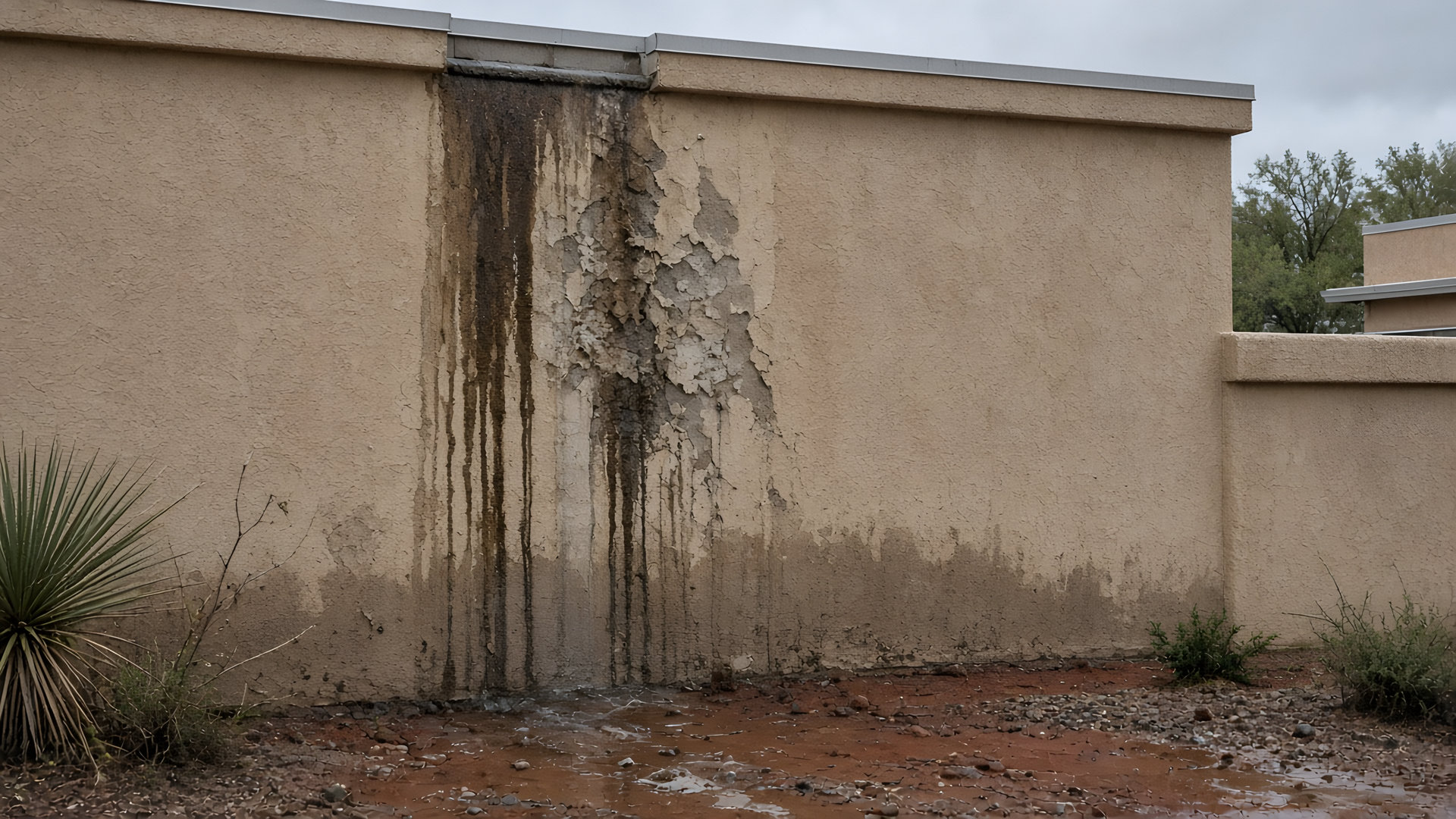
Tucson gets most of its rain in a few months of summer storms. Those storms come with wind that drives water sideways into every crack, and runoff that sits on flat roofs and along foundations. That is when stucco takes most of its water damage.
Where monsoon water gets into stucco
The monsoon season runs from mid-June through September, with most storms in July and August. Rain often comes fast and at an angle. It hits wall faces that never see rain the rest of the year.
On flat-roofed homes, water drains off through scuppers and canales in the parapet. If a scupper is short, loose or poorly flashed, water runs down the wall face or gets into the wall behind it. Dark streaks and a white crust under a scupper are the usual signs.
Parapet caps are the other weak spot. Cracks along the top of the parapet let water straight down into the wall. Windows are third, especially where the stucco meets the frame and the sealant has dried out.
Signs of water damage on stucco
Staining that stays dark long after a storm, or comes back every summer, means water is getting behind the surface. A white powdery crust, called efflorescence, is salt carried out of the wall by water as it dries.
Bubbling, bulging or soft areas mean the stucco has lost its bond. Inside the house, stains on drywall below windows or near the ceiling on outside walls point to the same thing.
At the base of the wall, look at the weep screed, the metal edge where the stucco stops above the ground. If soil or rock has been built up over it, water cannot drain out of the wall and the bottom of the stucco stays wet.
How we repair water damaged stucco
We find the water source first. Patching a stain without fixing the scupper or the window joint above it just moves the problem. Sometimes the fix is a longer scupper, new flashing at the parapet or new sealant at a window.
Then we open the damaged area. On frame walls we check the building paper, sheathing and lath, replace what is wet or rusted and let the framing dry. On block walls we remove loose stucco and clean the salts off the block. New coats are built up and finished to match.
Where soil is over the weep screed, we recommend grading it back so the base of the wall can drain. That is often the cheapest fix of all.
Caliche, drainage and the base of the wall
Many Tucson lots have caliche, a hard calcium layer in the soil. Water does not soak through it quickly, so roof runoff can pool along the foundation instead of draining away. Stucco near the ground stays wet, and the slab and soil move as they wet and dry.
Downspouts and canales that dump water right at the wall make this worse. Extending them, adding splash blocks or regrading so water moves away from the house does a lot to protect the stucco at the base.
Termites and wet walls
Subterranean termites are common around Tucson and become active after summer rains. Damp stucco at or below grade gives them a hidden path up into the framing. If we find mud tubes or damaged wood when a wall is open, we stop and tell you, so a pest company can treat it before the wall is closed.
What changes the cost of water damage repair
How far the water traveled is the big unknown. A stain under one scupper may only need a new scupper and a patch. A wall with wet sheathing across a wide area needs more opening, drying and rebuilding.
Access matters on parapets and second stories. Fixing the water source, such as flashing or roof drainage, may be a separate cost from the stucco itself.
Water and monsoon damage around Pima County
Water and monsoon damage questions
- Should I wait until the monsoon ends to fix water damage?
- Fix the water source as soon as you can, even with a temporary seal. The stucco repair itself goes better in dry weather, so many people seal in summer and do the full repair in fall.
- Is the white crust on my wall mold?
- Usually not. A white powder or crust on stucco is efflorescence, which is mineral salt left behind as water dries out of the wall. It is not harmful, but it shows that water is moving through the stucco.
- Does a roofer or a stucco contractor fix scupper leaks?
- It can be either, and sometimes both. The scupper and roof membrane are roof work. The stucco and flashing around the scupper on the wall face are stucco work. We look at the whole path the water takes and tell you which parts need which trade.
Talk to us about your wall
Call and describe what you have noticed. We will ask a few questions about the house and the problem, then book a time to see it.
If you can, take a wide photo and a close one before we talk. It helps us bring the right materials to the first visit.