
Stucco crack repair in Tucson, Arizona
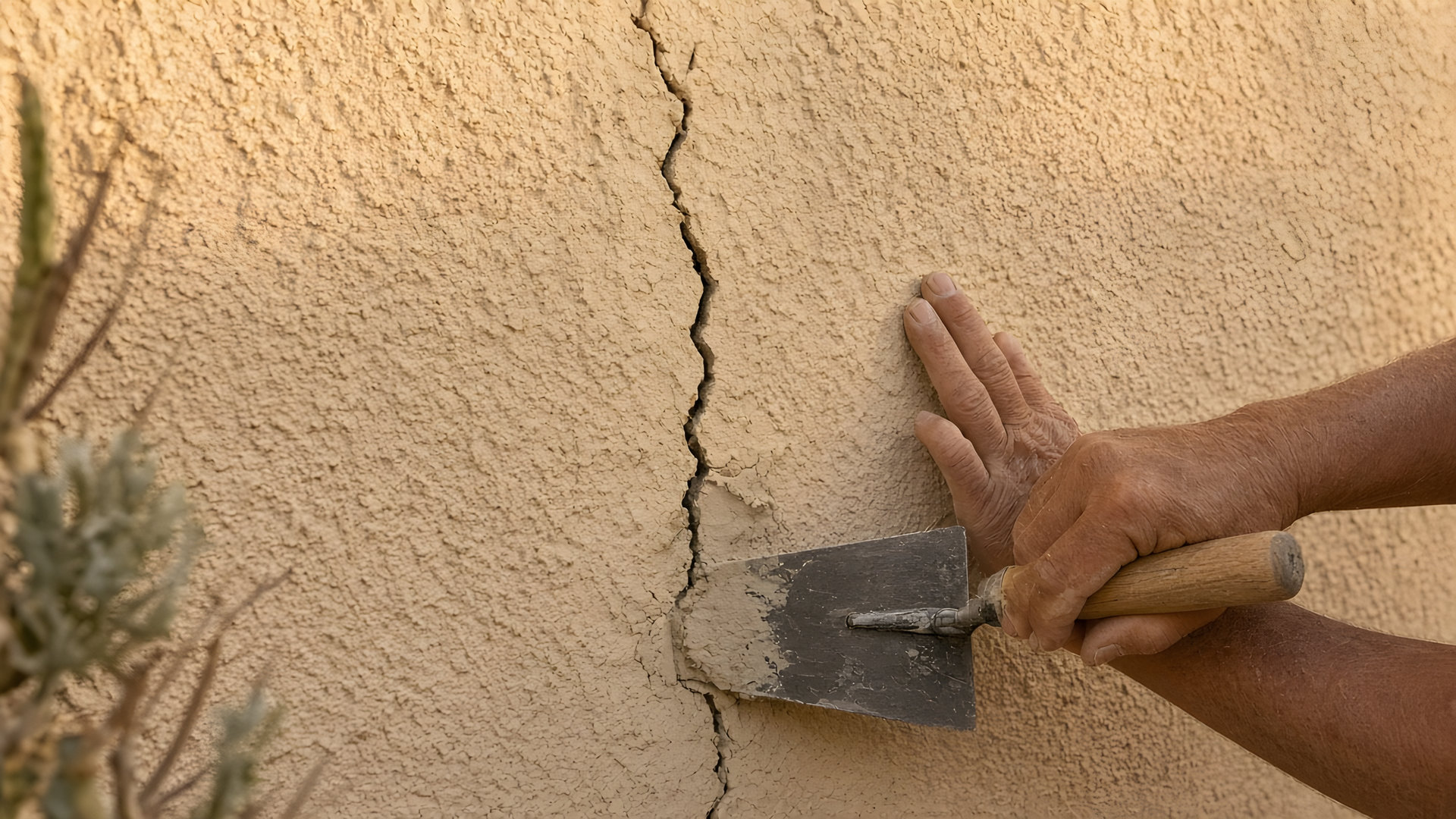
Most cracks in Tucson stucco are not a sign the house is failing. Some are. The repair starts with telling the two apart, then closing the crack so it stays closed and blends with the wall.
What the crack is telling you
Stucco is a thin cement skin, and it cracks when the wall behind it moves more than the skin can stretch. In Tucson that movement has a few sources. Summer heat swells the wall during the day and the desert night pulls it back. Soil under the slab takes on water in the monsoon and dries out by fall.
Hairline cracks that wander across a wall in a web pattern are usually shrinkage in the finish coat. They let a little water in but rarely go deeper. Straight cracks leaving window and door corners at an angle follow stress lines in the wall. Stair-step cracks on a block home follow the mortar joints underneath.
A crack wide enough to catch a fingernail, or one where one side sits proud of the other, gets a closer look before any patching. That kind of movement can come from settling, and covering it up does not stop it.
How we repair a stucco crack
Small cracks get opened slightly with a grinder or a hook tool so the repair has something to grip. We clean out the dust, dampen the edges and fill with a cement patching mix or a flexible acrylic filler. Which one depends on what the wall is made of and how much it still moves.
Wider cracks are cut back to sound material. On frame walls we check the lath and paper behind the crack, since water may have been getting in for a while. Where the wall moves with the seasons, fiberglass mesh goes into the base coat across the crack so the new coat can take that movement.
The last step is the finish. The patch gets a texture worked to match the wall around it, and then color. A crack that is filled but left smooth and gray is still easy to see from the street.
Cracks we see most on Tucson houses
Corner cracks at windows are the most common call. They show up on almost every stucco house in town at some point, and they are where wind-driven monsoon rain finds its way to the window frame.
Cracks along the parapet on flat-roofed homes come next. The parapet takes full sun on both faces and moves more than the wall below it. Water sitting on the roof finds those cracks quickly.
On older block homes in midtown and on the east side, long horizontal cracks near the base of the wall often line up with a course of block or the top of the footing. Those call for a look at drainage along the foundation as well as at the stucco.
When a crack needs more than a patch
If a crack keeps coming back in the same place, the wall is still moving. We will tell you that instead of patching it a third time. Sometimes the fix is a control joint cut into the stucco so the movement has a planned place to go. Sometimes it is a drainage problem to handle first, like a downspout emptying against the foundation.
If the crack looks structural, such as a wide crack with one side displaced or nearby doors that have started to stick, have a structural engineer look at the house before stucco work goes ahead. We can point out what we see. We do not make that call for you.
What changes the cost of crack repair
The number of cracks and their width matter most. A handful of hairline cracks on one wall is a short visit. Cracks that need cutting back, mesh and a new finish across a whole wall take longer and use more material.
Height and access matter too. A crack along a second story or a parapet needs ladders or scaffold. Color is the other factor. A painted wall can be touched up and repainted, while integral color stucco needs a matched finish coat, which takes more time to get right.
Crack repair around Pima County
Crack repair questions
- Can I fill stucco cracks with caulk myself?
- For a hairline crack, a paintable elastomeric caulk will keep water out for a while. It usually shows, because caulk does not take texture the way stucco does. Avoid silicone. Paint and patch material will not stick to it, and it has to be cut out before a proper repair.
- Do hairline cracks mean my foundation is moving?
- Usually not. Hairline map cracking is mostly shrinkage in the finish coat as it cured. Cracks that grow, open more than about 3 mm or show an offset between the edges are the ones worth watching.
- What time of year is best for crack repair in Tucson?
- Spring and fall are easiest, because a patch cures more evenly when it is not over 100 degrees. Fixing cracks before the monsoon starts in July keeps summer storms out of the wall. Summer work is possible with early starts and keeping the patch damp.
Talk to us about your wall
Call and describe what you have noticed. We will ask a few questions about the house and the problem, then book a time to see it.
If you can, take a wide photo and a close one before we talk. It helps us bring the right materials to the first visit.