
Stucco patching and hole repair in Tucson, Arizona
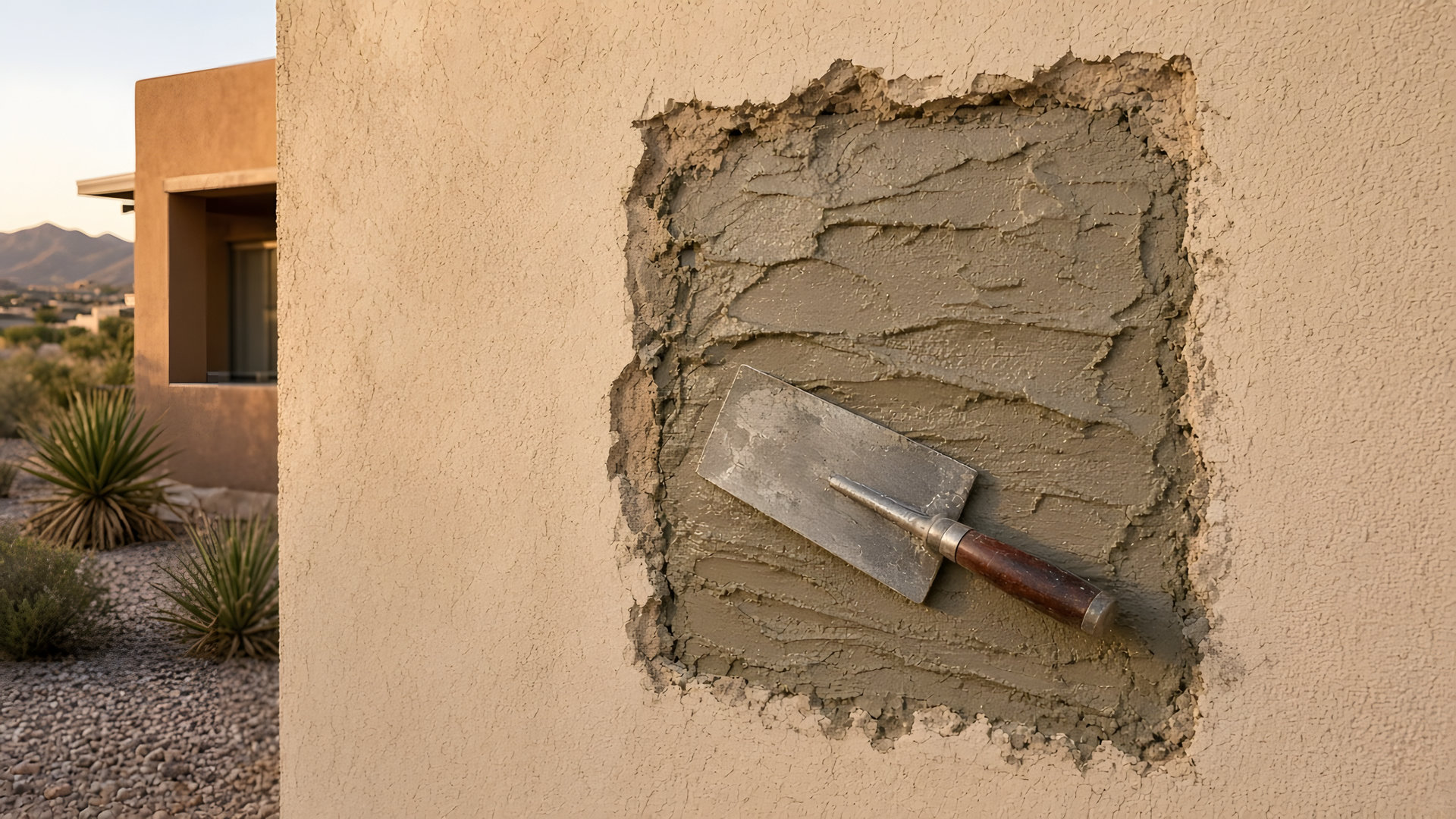
A good patch is built the same way the wall was built, in layers, with each one given time to set. Done that way it holds as long as the wall around it and is hard to pick out once it is finished.
What usually needs a patch
Most patches cover something that was taken off the wall. An old swamp cooler line, a satellite dish mount, a light fixture that moved or a dryer vent that was rerouted. Each one leaves a hole and a ring of screw holes around it.
Impact damage is the next group. A car door, a ladder, a pool cue or a hailstone. On frame walls the stucco may look like it has only a dent, but it often has a crushed area behind it and loose material around the edge.
Then there are soft spots. Press on the wall and it gives, or tap on it and it sounds hollow. That usually means water has been getting behind the stucco and the bond has failed. Those patches are bigger than they first look.
How a stucco patch is built
We cut the damaged area back to a clean square or rectangle with sound edges. Clean lines are easier to blend than a ragged hole. On a frame wall we check the building paper and lath and replace what is torn or rusted, lapping new paper under the old so water runs out, not in.
Then the layers go on. First comes a scratch coat, pushed into the lath and raked with grooves for the next layer to key into. The brown coat brings the patch out flush with the wall and is floated flat. On a block wall the base coat goes straight onto the block after the surface is cleaned and wet down.
Each coat needs time to cure. Cement stucco gains strength while it stays damp, so in dry Tucson air we mist the patch between coats. Rushing that step is the main reason patches crack around their edges a few months later.
Making the patch disappear
The finish coat is where a patch either blends or shows. We feather it past the edges of the repair so there is no hard line, and work the texture to match the wall. Sand finish, light dash, skip trowel and smooth Santa Fe finishes each take a different tool and a different hand.
Color is the last step. If the wall is painted, the patch gets primed and the wall is repainted to the nearest corner or break so the sheen matches too. If the wall has color in the stucco itself, we match the finish coat color, which our color and texture page covers in more detail.
Patches on older Tucson homes
Houses in Barrio Viejo, Armory Park and other older neighborhoods are often adobe or fired brick with a lime or mud plaster finish. Patching those with hard cement stucco traps moisture in the adobe and pulls away over time. On walls like that we use a lime-based patch that lets the adobe dry out.
Older block homes from the 1950s and 1960s across midtown usually have a thin cement finish straight on the block. Those patch well, but the old finish is often brittle, so we check the area around the damage before deciding how big the patch should be.
What changes the cost of a patch
Size is the obvious factor, but what is behind the stucco matters more. A small hole on a sound block wall is quick. The same hole on a frame wall with wet paper behind it may grow once the edges are opened up.
Texture and color matter as well. A patch on a plain sand finish in a painted wall is simpler than a patch on a hand-troweled finish with integral color. We tell you before we start if blending the patch means refinishing a larger area.
Stucco patching around Pima County
Stucco patching questions
- Does a patch match the wall around it?
- On a painted wall it will match once the wall is repainted to a natural break. On integral color stucco a small patch can come close, and the wall may still show a slight difference until the whole face is refinished. We say which case you have before work starts.
- How long does a stucco patch take?
- A small patch usually takes a visit or two. A deeper patch on a frame wall takes three or more, because each coat needs a day or more to cure before the next goes on. Summer heat and winter cold both slow that down.
- Can you patch around a new window or door?
- Yes. Window and door changes leave a gap of cut stucco around the new frame. We tie new paper into the window flashing, rebuild the coats and finish the band so the opening looks original.
Talk to us about your wall
Call and describe what you have noticed. We will ask a few questions about the house and the problem, then book a time to see it.
If you can, take a wide photo and a close one before we talk. It helps us bring the right materials to the first visit.